About PARAM Smriti
The supercomputer of 838 TFLOPS capacity, built at the cost of Rs 32.5 crore under the National Super Computing Mission at National Agri-Food and Bio-manufacturing Institute (NABI), Mohali
PARAM Smriti Details
| System Specifications | |
|---|---|
| Theoretical Peak Floating-point Performance Total (Rpeak) | 838 TFLOPS |
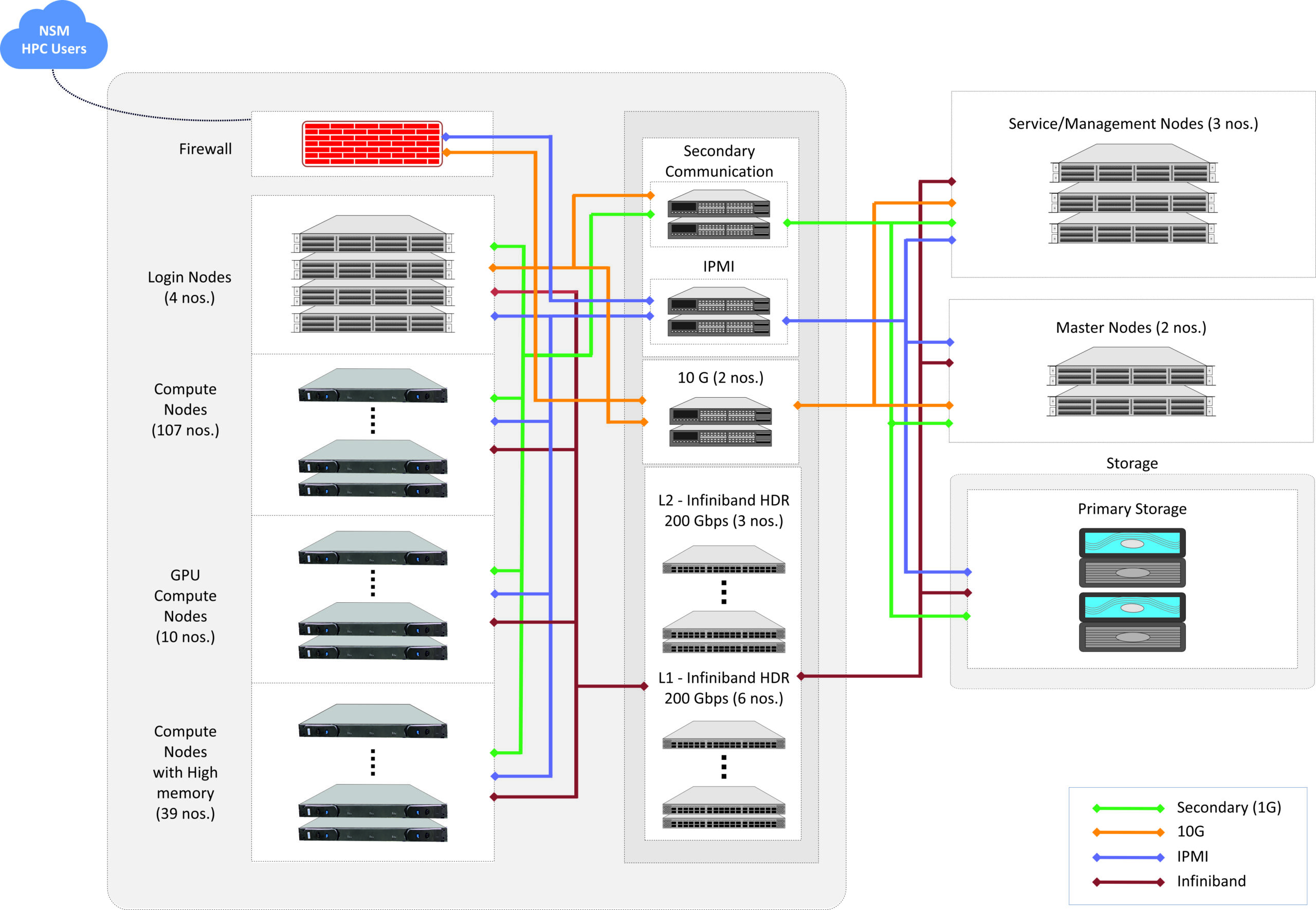
| Base Specifications (Compute Nodes) | 2 X Intel Xeon Cascadelake 8268, 24 Cores, 2.9 GHz, Processors per node, 192 GB Memory, 480 GB SSD |
| Master/Service/Login Nodes | 10 nos. |
| CPU only Compute Nodes (Memory) | 107 nos. (192GB) |
| GPU Nodes (Memory) | 10 nos. (192GB) |
| High Memory Compute Nodes | 39 nos. (768GB) |
| Total Memory | 52.416 TB |
| Interconnect | Primary: 100Gbps Mellanox Infiniband Interconnect network 100% non-blocking, fat tree topology Secondary: 10G/1G Ethernet Network Management network: 1G Ethernet |
| Storage | 1PiB PFS based storage |
| CPU Only Compute Nodes | |
|---|---|
| Nodes | 107 |
| Cores | 5136 |
| Compute Power of Rpeak | 476.6 TFLOPS |
| Each Node with | 2 X Intel Xeon Cascadelake 8268, 24 cores, 2.9 GHz, processors 192 GB memory 480 GB SSD |
| GPU Only Compute Nodes | |
|---|---|
| Nodes | 10 |
| CPU Cores | 400 |
| CUDA Cores | 102400 |
| Rpeak | CPU 32 TFLOPS + GPU 156 TF |
| Each Node with | 2 X Intel Xeon Skylake 6248, 20 cores, 2.5 GHz, processors 192 GB Memory 2 x NVIDIA V100 SXM2 GPU Cards 480 GB SSD |
| High Memory Compute Nodes | |
|---|---|
| Nodes | 39 |
| CPU Cores | 1872 |
| Compute Power of Rpeak | 173.7 TFLOPS |
| Each Node with | 2 X Intel Xeon Cascadelake 8268, 24 cores, 2.9 GHz, processors 768 GB Memory 480 GB SSD |
Architecture Diagram:
Software Stack:

Installed Applications/Libraries
HPC Applications
- Bio-informatics: MUMmer, HMMER, MEME, PHYLIP, mpiBLAST, ClustalW
- Molecular Dynamics: NAMD (for CPU and GPU), LAMMPS, GROMACS
- CFD: OpenFOAM, SU2
- Material Modeling, Quantum Chemistry: Quantum-Espresso, Abinit, CP2K, NWChem
- Weather, Ocean, Climate: WRF-ARW, WPS (WRF), ARWPost (WRF), RegCM, MOM, ROMS
Deep Learning Libraries
- cuDNN, TensorFlow, Theano
Dependency Libraries
- NetCDF, PNETCDF, Jasper, HDF5, Tcl, Boost, FFTW
Support
For any support, contact: smriti.support@nabi.res.in
PARAM Smriti Usage Report
Link To Be Added
*Note: The above data is coming from C-Chakshu (Multi Cluster Monitoring Platform)
Publication
There are a total of 29 publications that have been published using PARAM Smriti till 2023.


